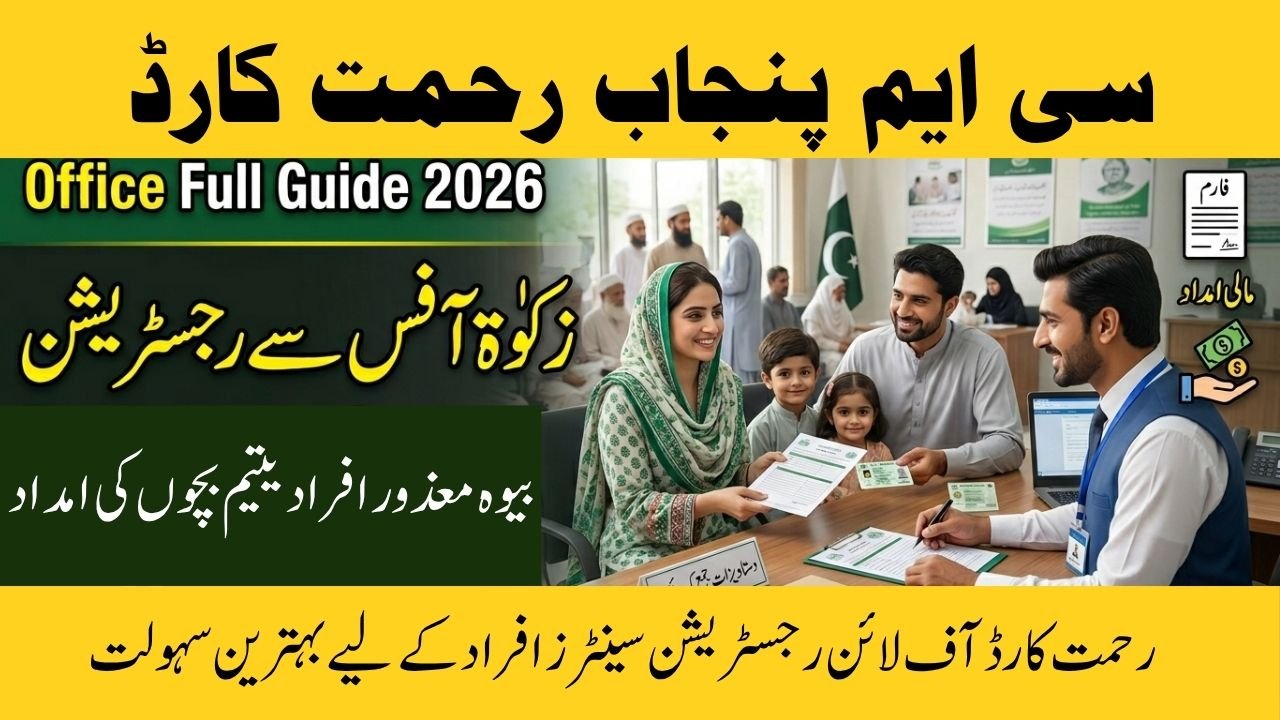
CM Punjab Rahmat Card
For thousands of deserving families across Punjab, rising inflation has made daily expenses increasingly difficult to manage. To address these challenges, the Punjab Government introduced the Rahmat Card program, a welfare initiative designed to provide financial assistance to eligible low-income households.
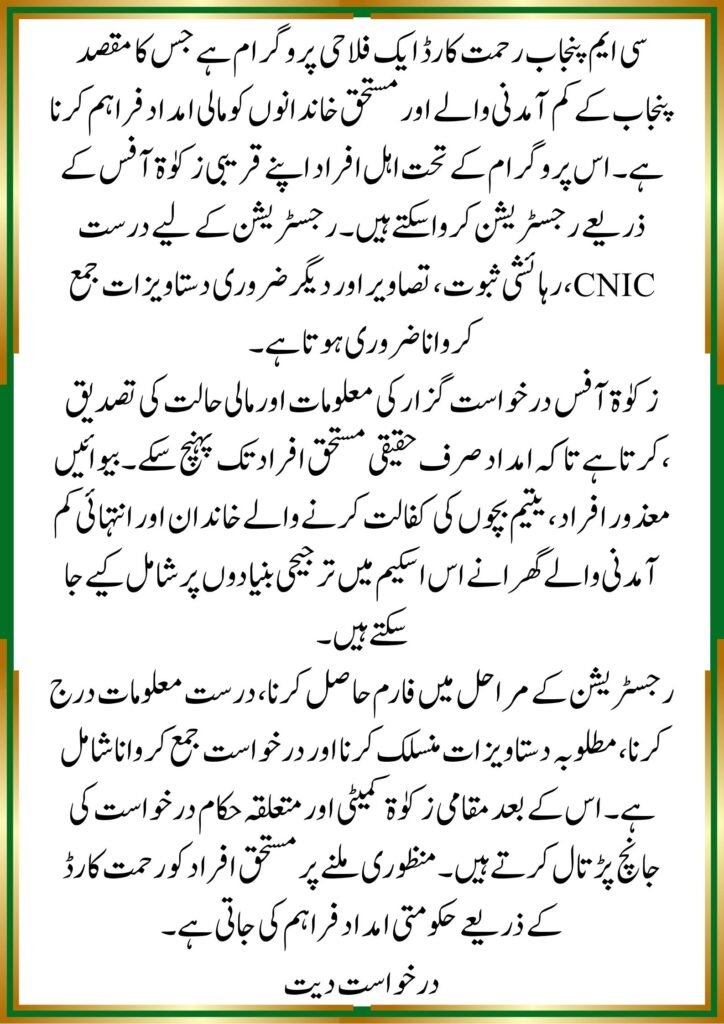
Many applicants are unaware that one of the easiest ways to register is through their local Zakat Office. This guide explains the complete registration process, eligibility requirements, required documents, verification procedures, and common mistakes to avoid when applying through a Zakat Office.
Whether you’re applying for yourself or helping a family member, this article covers everything you need to know.
What Is the CM Punjab Rahmat Card Program?
The Rahmat Card is a social welfare initiative launched by the Punjab Government to support financially vulnerable families. The program aims to provide direct financial relief to deserving citizens who struggle with basic household expenses.
Unlike traditional aid distribution methods, the Rahmat Card system focuses on transparent verification and targeted assistance to ensure benefits reach those who need them most.
Key Objectives of the Program
- Reduce financial pressure on low-income households
- Improve access to government welfare benefits
- Ensure transparent aid distribution
- Support widows, disabled individuals, and deserving families
- Strengthen social protection mechanisms across Punjab
Why the Government Introduced Rahmat Card
Over the past few years, inflation, rising utility costs, and economic uncertainty have increased financial hardship for many families.
The Rahmat Card initiative was introduced to create a structured and accountable support system that identifies deserving households through verified records and local-level assessments.
Why Register Through a Zakat Office?
Many people search for online registration methods, but Zakat Offices remain one of the most reliable channels for Rahmat Card registration.
Local Zakat Offices play a crucial role in verifying applicants and forwarding eligible cases to relevant authorities.
Benefits of Zakat Office Registration
- Direct assistance from government staff
- Help with application forms
- Local verification process
- Reduced documentation errors
- Easier eligibility assessment
Role of District and Tehsil Zakat Offices
The Zakat Office serves as an important verification point.
Officials review applicant information, verify supporting documents, and coordinate with local committees to confirm eligibility before approval.
How Zakat Committees Verify Applicants
Verification typically includes:
- CNIC authentication
- Household income review
- Residence confirmation
- Family size assessment
- Socioeconomic evaluation
This process helps ensure that financial assistance reaches genuinely deserving families.
Eligibility Criteria for CM Punjab Rahmat Card Registration
Before visiting a Zakat Office, applicants should confirm that they meet the program’s eligibility requirements.
Basic Eligibility Requirements
Applicants generally must:
- Be permanent residents of Punjab
- Possess a valid CNIC
- Belong to a low-income household
- Not hold significant assets or property
- Meet government poverty assessment criteria
Priority Categories
Certain groups may receive priority consideration:
Widows
Women who have lost their primary earning family member often qualify for special assistance.
Persons with Disabilities
Individuals with certified disabilities may receive preference during evaluation.
Orphans and Vulnerable Families
Households caring for orphaned children are often considered deserving cases.
Senior Citizens
Elderly individuals without stable income sources may also qualify.
Who May Be Declared Ineligible?
Applicants may face rejection if they:
- Provide incorrect information
- Own substantial assets
- Hold government jobs with regular salaries
- Fail verification checks
- Submit incomplete documents
Required Documents for Rahmat Card Registration
Preparing documents beforehand can significantly speed up the registration process.
Essential Documents
Applicants should carry:
- Original CNIC
- CNIC copies
- Recent passport-size photographs
- Proof of residence
- Family Registration Certificate (if required)
Income-Related Documents
Where applicable:
- Salary certificate
- Income declaration
- Pension details
- Disability certificate
- Widow certificate
Additional Supporting Documents
Depending on individual circumstances, officials may request:
- Utility bills
- B-Form copies of children
- Medical certificates
- Zakat recommendation letters
Having complete documentation improves approval chances and minimizes delays.
Step-by-Step CM Punjab Rahmat Card Registration via Zakat Office
Many applicants find the process straightforward once they understand the steps involved.
Step 1: Visit Your Nearest Zakat Office
Locate the Zakat Office serving your district or tehsil.
Visit during official working hours and request information regarding Rahmat Card registration.
Step 2: Obtain the Registration Form
Officials will provide the application form or direct you to the designated registration desk.
Read all instructions carefully before filling out the form.
Step 3: Complete the Application Form
Provide accurate information, including:
- Full name
- CNIC number
- Address
- Family details
- Income information
- Contact number
Avoid overwriting or leaving mandatory fields blank.
offichal website ; https://punjab.gov.pk/rahmat-card
Step 4: Attach Required Documents
Attach photocopies of all required documents.
Ensure that every copy is clear and readable.
Step 5: Submit the Application
Submit your completed form to the designated officer.
You may receive an acknowledgment receipt or registration reference number.
Step 6: Verification Process
Local authorities and Zakat Committees may verify:
- Household conditions
- Income status
- Residence information
- Family circumstances
Step 7: Approval and Card Issuance
Once verification is completed and approved, applicants may receive notification regarding their Rahmat Card status.
Approved beneficiaries can then access program benefits according to government guidelines.
Common Mistakes That Delay Registration
A significant percentage of applications experience delays due to avoidable errors.
Incorrect CNIC Information
Even a small mistake in the CNIC number can create verification issues.
Always double-check your details before submission.
Incomplete Documentation
Missing documents are among the leading causes of application delays.
Create a checklist before visiting the office.
Providing Outdated Contact Information
Incorrect mobile numbers prevent officials from contacting applicants regarding verification or approval updates.
Submitting False Information
Verification teams routinely cross-check applicant information.
Any discrepancy may result in rejection.
How Long Does Rahmat Card Approval Take?
Processing times can vary depending on:
- District workload
- Verification requirements
- Application volume
- Document completeness
Typical Processing Timeline
In many cases:
- Initial submission: Same day
- Verification stage: Several days to a few weeks
- Final approval: Subject to government review
Applicants should remain patient and keep their contact information active.
Can Applicants Track Their Status?
Depending on government procedures, applicants may:
- Contact the Zakat Office
- Use official helplines
- Check announcements from relevant authorities
Always rely on official sources for updates.
People Also Ask (PAA)
Is Rahmat Card registration free?
Yes. Eligible applicants should not be charged any registration fee during the official registration process.
Can I apply without visiting a Zakat Office?
Depending on future government updates, online options may become available. However, Zakat Office registration remains a primary verification channel in many areas.
What happens if my application is rejected?
Applicants can seek clarification from local authorities and may reapply if deficiencies are corrected.
Can widows apply for the Rahmat Card?
Yes. Widows are often considered a priority category under welfare programs.
Is a poverty score required for approval?
Government programs commonly use socioeconomic assessments and verification mechanisms to evaluate eligibility.
How can I find my nearest Zakat Office?
You can contact your district administration office or local government representatives for guidance.
Can disabled individuals receive benefits through Rahmat Card?
Yes. Eligible persons with disabilities may qualify, subject to verification and supporting documentation.
Expert Insights on Successful Registration
After reviewing multiple welfare registration systems across Pakistan, one consistent pattern emerges: complete and accurate documentation dramatically improves approval rates.
Applicants who prepare all required documents before visiting the Zakat Office typically experience faster processing and fewer verification issues.
Another important observation is that local verification committees often prioritize transparency and accuracy. Families should provide truthful information and cooperate fully during assessments.
Finally, maintaining updated CNIC records and active mobile numbers helps ensure smoother communication throughout the registration process.
Final Thoughts
The CM Punjab Rahmat Card program represents an important step toward supporting financially vulnerable families across Punjab. Registering through a Zakat Office remains one of the most practical and accessible methods for eligible applicants.
By understanding the eligibility criteria, preparing complete documentation, and following the registration process carefully, applicants can improve their chances of successful approval.
If you believe your household qualifies for assistance, gather your documents, visit your nearest Zakat Office, and begin the registration process as early as possible.
Frequently Asked Questions (FAQ)
1. What is the purpose of the Rahmat Card?
The Rahmat Card provides financial assistance to deserving and low-income families in Punjab.
2. Can I register through any Zakat Office?
Applicants should generally register through the Zakat Office serving their local area.
3. Is CNIC mandatory for registration?
Yes, a valid CNIC is usually required.
4. Are disabled persons eligible?
Yes, subject to verification and eligibility requirements.
5. Can widows receive priority consideration?
Yes, widows are often included among priority categories.
6. How long does approval take?
Processing times vary depending on verification and administrative workload.
7. Is there any registration fee?
No, official registration should be free of charge.