Pakistan Federal Budget 2026-27
Waiting for the annual federal budget statement in Pakistan feels a lot like sitting in a high-stakes waiting room. For the country’s massive community of public sector workers, the announcement isn’t just about macroeconomic indicators, FBR revenue targets, or IMF loan conditionalitiesit directly dictates their household purchasing power for the next twelve months.
As the Ministry of Finance finalizes the Pakistan Federal Budget 2026-27, the primary question echoing through every government department from Islamabad to Karachi is simple: How much of a raise are we actually getting, and will it be enough to survive inflation?
Balancing public sector expectations against stringent economic reforms is a notoriously difficult tightrope walk. This comprehensive breakdown explores the definitive salary increases, ad-hoc relief allowances, revised pay scales, and new income tax brackets impacting government employees in the 2026-27 financial year.
Table of Contents
The Core Blueprint of the 2026-27 Salary Increase
Every fiscal year, the federal government alters the compensation matrix for government employees using distinct financial mechanisms. Understanding how these tools function helps clarify the actual impact on a monthly paycheck.
Breaking Down the Expected Ad-Hoc Relief Allowance
The most common way the Pakistani government adjusts public sector pay without permanently restructuring the pension foundation is through an Ad-Hoc Relief Allowance. For the upcoming fiscal year 2026-27, initial proposals from the finance division heavily favor a tiered allowance structure.
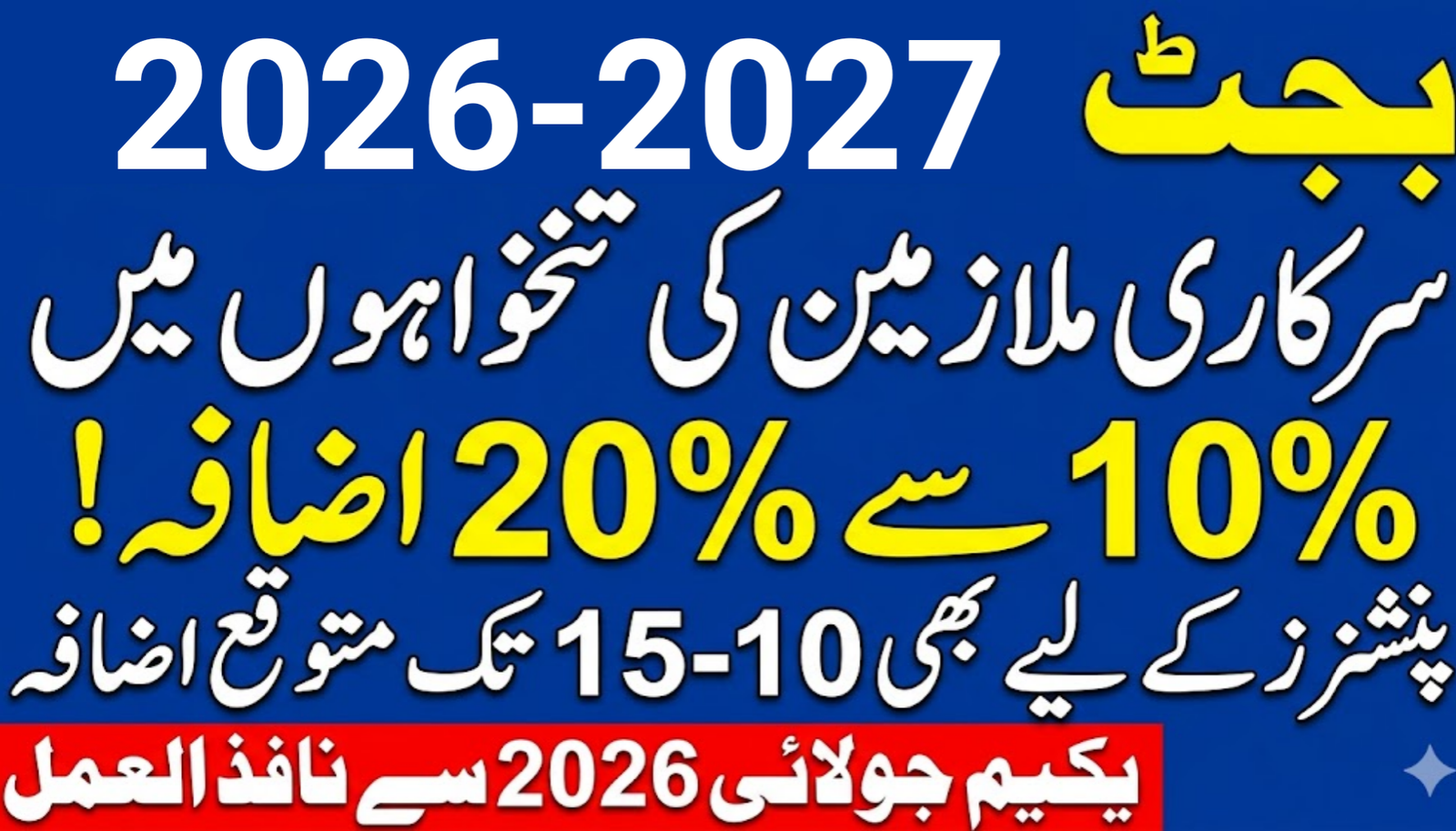
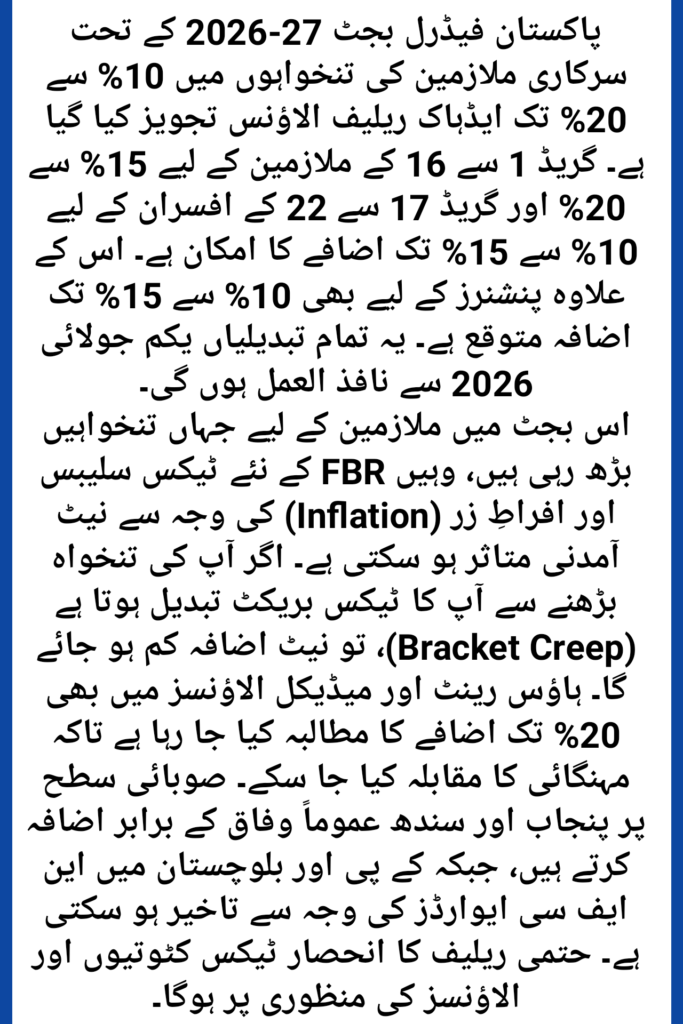
According to sources close to the budget committee, the government is leaning toward an increase of 10% to 15% for senior officers in BPS-17 to BPS-22, while offering a more substantial cushion of 15% to 20% for lower-tier employees in BPS-1 to BPS-16. This tiered strategy acts as a targeted buffer, ensuring that those most vulnerable to consumer price spikes receive a higher proportion of relief.
Will There Be a Basic Pay Scale Revision in 2026?
A question running rampant across public sector forums is whether the government will merge previous ad-hoc allowances into a clean, revised Basic Pay Scale (BPS) for 2026. The last major pay scale revision occurred in 2022. Historically, these revisions take place every four to five years to streamline the pay structure.
“Historical BPS Revisions Track:
2016 Base Scales ➔ 2017 Revised Scales ➔ 2022 Revised Scales ➔ 2026-27 Proposed Structural Shift”
While a total restructuring requires massive fiscal space, employee unions are actively lobbying for a 2026 consolidation. If approved, merging older allowances into the basic salary would permanently bump up the calculation metrics for pensions, house rent, and future medical allowances.
How Much Will Government Employee Salaries Increase in Pakistan for 2026-27?
Initial drafts presented to the federal cabinet projected a flat 10% increment across the board. However, strong resistance from employee alliances alongside rising utility tariffs forced a reassessment.
The compromise currently taking shape targets an estimated 10% to 15% adjustment, designed as an ad-hoc measure to satisfy IMF structural benchmarks while preventing widespread labor strikes.
The Widening Disparity Between BPS-1 to BPS-16 vs BPS-17 to BPS-22
In Pakistan’s bureaucracy, the divide between operational staff (BPS 1-16) and gazetted officers (BPS 17-22) grows sharper under high inflation. A 10% increase on a BPS-5 salary adds very few absolute rupees to a grocery budget compared to the same percentage applied to a BPS-20 officer’s base.
To bridge this gap, the establishment division is considering adjusting fixed non-salary perks—such as transport and utility subsidies exclusively for lower-scale staff to equalize the real-world value of the relief package.
Inflation vs. Indexation: The Real Value of Your Paycheck
To understand why public sector workers feel perpetually squeezed, we must look at the concept of wage indexationadjusting salaries in lockstep with the Consumer Price Index (CPI).
How Does the 2026 Salary Hike Compare to Current Inflation?
If inflation hovers around 12% to 14% annually, any salary increase below that threshold is technically a pay cut in terms of actual purchasing power.
An ad-hoc allowance of 15% does not mean employees are getting 15% richer; it simply means their standard of living is breaking even with the market. When flour, electricity, and fuel costs rise sharply, a nominal salary hike merely prevents households from falling deeper into deficit.
Can Upgrades to the House Rent and Medical Allowances Offset Costs?
Aside from basic salary, allowances form a critical portion of a government employee’s monthly take-home pay. For the 2026-27 fiscal plan, there is strong pressure to adjust:
- House Rent Allowance (HRA): Currently pegged to outdated rental benchmarks in major urban centers like Islamabad, Lahore, and Karachi.
- Medical Allowance: Lower-scale employees face static medical allocations that fail to match the real-world cost of healthcare and prescription medication.
An upward revision of these secondary allowances by even 20% would offer tangible, untaxed relief without drastically altering the core basic pay structure.
The Salaried Class Tax Trap: New Income Tax Brackets
A higher gross salary looks excellent on paper, but the net take-home pay is ultimately decided by the Federal Board of Revenue (FBR). The upcoming budget includes a dual focus: increasing salaries while simultaneously broadening the tax net.
How Will New FBR Tax Brackets Impact Your Net Income?
As part of the revenue generation targets set for FY 2026-27, the FBR is modifying the tax slabs for the salaried class. If the non-taxable income threshold remains unchanged while nominal salaries rise, thousands of lower-middle-class employees risk being pushed into higher tax brackets. This economic phenomenon is known as bracket creep.
| Current Taxable Income Slab (PKR) | Proposed 2026-27 Tax Rate Alteration |
| Up to 600,000 | Expected to remain tax-exempt (0%) |
| 600,000 – 1,200,000 | Slight progressive adjustment to broaden base |
| 1,200,000 – 2,400,000 | Expected marginal percentage increase |
| Above 2,400,000 | Higher progressive rates to capture revenue |
Will Public Sector Employees Face Higher Deductions?
Yes. If you receive a 15% ad-hoc relief allowance but the FBR adjusts your tax slab upward by 2.5%, your actual net income increase shrinks significantly. Employees must look at their net pay slip rather than the gross percentage increase announced by the Finance Minister on the assembly floor.
Provincial Budgets: Will Punjab, Sindh, KP, and Balochistan Match the Federal Relief?
In Pakistan’s devolved fiscal setup, a federal budget announcement is only the first piece of the puzzle. Once Islamabad sets its strategy, the provincial leadership must decide whether to replicate it.
Tracking the Provincial Disparities in Salary Increases
Historically, provinces like Punjab and Sindh often match or occasionally exceed federal salary increases to maintain labor harmony. However, Khyber Pakhtunkhwa (KP) and Balochistan face unique cash-flow constraints, meaning their decisions often lag behind by several weeks.
- Punjab & Sindh: Generally fast-track their budget approvals to align closely with the federal ad-hoc percentages.
- KP & Balochistan: Dependent on timely National Finance Commission (NFC) award transfers, occasionally leading to delayed implementation or modified, lower allowances.
This creates an environment where two employees under the exact same pay scale (e.g., BPS-17) can end up with visibly different monthly take-home pays depending on their geographic post.
Frequently Asked Questions
What is the expected salary increase percentage for government employees in Budget 2026-27?
The federal government is widely expected to announce an Ad-Hoc Relief Allowance ranging between 10% and 15% for officers in BPS-17 to BPS-22, and up to 15% to 20% for employees in BPS-1 to BPS-16.
When will the Pakistan Federal Budget 2026-27 salary increase take effect?
Once approved by the National Assembly, all salary raises, ad-hoc allowances, and revised tax adjustments traditionally take effect at the start of the new fiscal year, which begins on July 1, 2026.
What is the difference between an Ad-Hoc Relief Allowance and a Basic Pay Scale revision?
An Ad-Hoc Relief Allowance is a temporary monthly bonus calculated from your existing basic pay that does not change your core pay scale or future pension base. A Basic Pay Scale revision merges past allowances into a brand-new base salary, permanently elevating all dependent allowances and retirement benefits.
Will pensions also increase in the upcoming 2026-27 budget?
Yes, retired government employees typically receive a pension increase alongside active workers. The proposed pension hike for FY 2026-27 is estimated to fall between 10% and 15% to help pensioners cope with utility price adjustments.
How does bracket creep affect my budget salary hike?
Bracket creep happens when inflation forces the government to give you a nominal raise, pushing your total income into a higher FBR tax bracket. As a result, you pay a higher percentage in taxes even though your real purchasing power hasn’t actually improved.
The Strategic Outlook for Public Sector Workers
The Pakistan Federal Budget 2026-27 is shaping up to be a calculated compromise. The state must carefully manage its massive public wage bill to meet macroeconomic targets while providing its workforce with enough relief to survive persistent inflationary pressures.
For the average government employee, the upcoming announcement will provide some financial breathing room, but the real test lies in the fine print. True relief will depend on how aggressively the FBR taxes these new adjustments and whether secondary allowances are upgraded to match the actual costs of modern living. Stay tuned as the final budget bill moves through parliament this June.