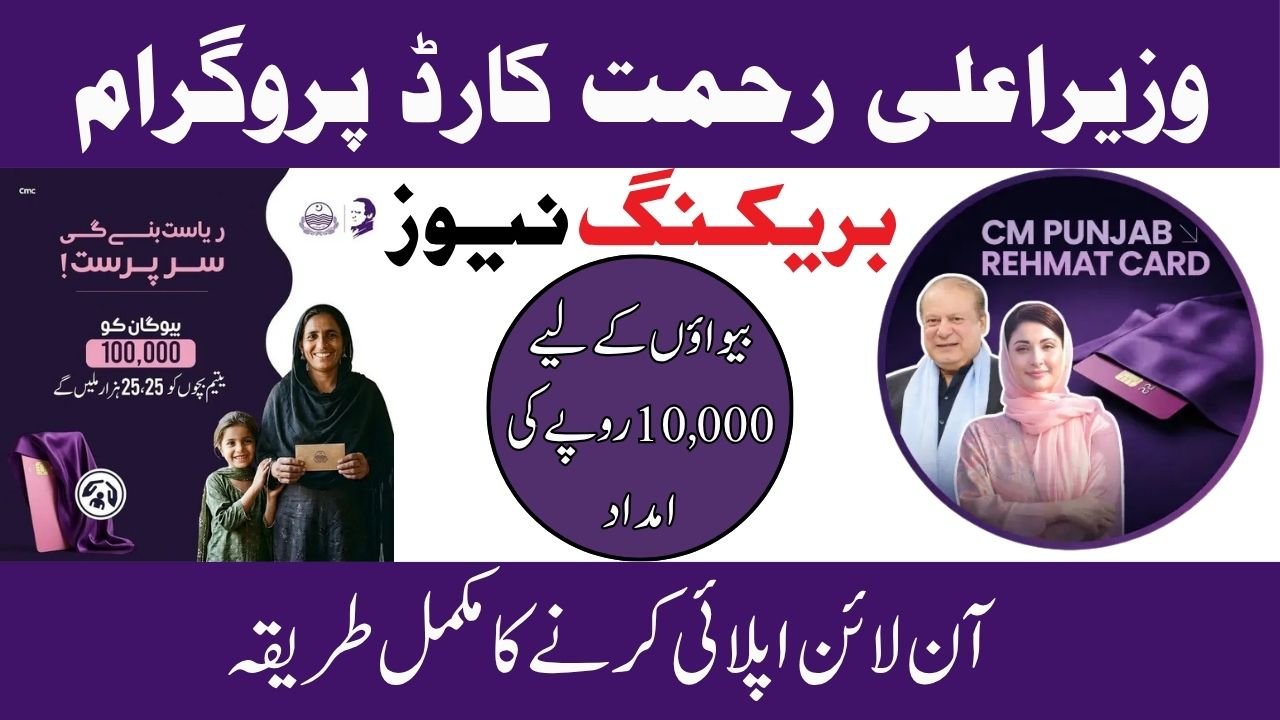
Rahmat Card in Punjab
The Rahmat Card is generally described as a social welfare initiative aimed at providing financial relief to low-income families in Punjab. While different districts may use slightly different implementation methods, the goal remains the same: helping deserving households meet basic needs like food, health, and utilities.
Unlike fully digital programs, many applicants still rely on offline registration centers, especially in rural areas where internet access is limited.
Think of it like this:
If the government is the system, then these centers are the “physical doors” where you walk in and apply face-to-face.
Who Can Apply for Rahmat Card?
Eligibility typically focuses on:
- Low-income households
- Widows and orphan guardians
- Disabled individuals
- Families already registered in government welfare databases
- Daily wage workers with unstable income
In many cases, data is cross-checked with NADRA and social welfare databases to verify eligibility.
Why Offline Registration Still Matters in 2026
Even in 2026, offline systems are important because:
- Many rural citizens lack smartphones or internet access
- Document verification still requires in-person checking
- Government centers reduce fraud and fake applications
- On-ground staff can guide applicants step-by-step
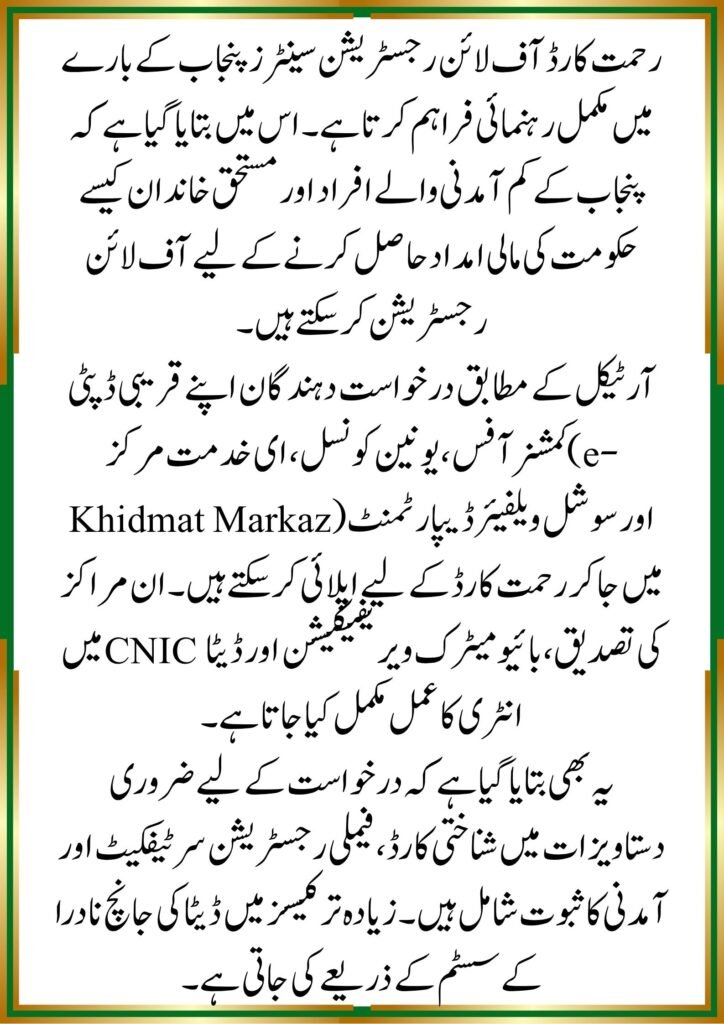
Rahmat Card Offline Registration Centers in Punjab
Now let’s come to the most important part: where you can actually apply offline in Punjab.
Instead of relying on a single office, the government uses multiple authorized facilitation points.
1. Deputy Commissioner (DC) Office
Every district in Punjab has a Deputy Commissioner Office, which often acts as a central hub for welfare registrations.
At DC offices, you can:
- Submit application forms
- Get document verification
- Receive guidance on eligibility
This is usually the most reliable first stop.
2. e-Khidmat Markaz Punjab
One of the most structured options is:
- e-Khidmat Markaz
These centers are designed to provide multiple government services under one roof.
You can:
- Apply for welfare programs
- Submit biometric verification
- Track application status
- Get assistance from trained staff
They are especially helpful in urban and semi-urban areas.
3. Union Council Offices
Union Council offices are often the closest local-level registration point for most citizens.
Here you can:
- Verify household details
- Get basic registration forms
- Confirm family income status
For rural users, this is often the easiest access point.
4. Social Welfare Department Offices
The Punjab Social Welfare Department plays a major role in screening applicants.
Services include:
- Poverty assessment
- Disability verification
- Widow support registration
These offices usually handle more detailed eligibility checks.
5. BISP-Linked Facilitation Points
In many districts, registration overlaps with national welfare databases like:
- Benazir Income Support Programme
While not directly “Rahmat Card offices,” these centers may help verify eligibility or redirect applicants.
Step-by-Step Offline Registration Process
Understanding the process saves time and frustration. Here’s how it usually works:
offichal website ; https://punjab.gov.pk/rahmat-card
Step 1 – Visit the Nearest Center
Go to:
- DC Office OR
- e-Khidmat Markaz OR
- Union Council
Take your original documents.
Step 2 – Obtain Application Form
Ask for the Rahmat Card / welfare registration form.
Fill it carefully with:
- CNIC number
- Household details
- Income information
Step 3 – Document Verification
Staff may verify your identity using:
- NADRA database
- Family registration certificate
- Utility bills (if required)
Step 4 – Data Entry and Biometric Check
In most centers:
- Fingerprint verification is done
- Data is entered into government system
- Application receipt is issued
Step 5 – Wait for Confirmation
After submission:
- You may receive SMS updates
- Or follow up at the same center
Processing time varies by district workload.
Required Documents for Rahmat Card Registration
To avoid repeated visits, keep these ready:
- Original CNIC
- Family Registration Certificate (FRC)
- Income proof (if available)
- Disability certificate (if applicable)
- Utility bill copy
Expert insight:
Most application delays happen not due to eligibility, but missing or mismatched NADRA records. Always ensure your CNIC data is updated.
Common Problems Faced During Offline Registration
Even simple processes can get confusing. Here are common issues:
1. Long Waiting Time
Centers are often crowded, especially during new scheme announcements.
2. Incomplete Records
If your household data is outdated, the system may reject your application.
3. Lack of Awareness
Many applicants don’t know which center is officially authorized.
4. Fake Agents
Be careful of people claiming “guaranteed approval” — government registration is always free.
Expert Tips to Increase Approval Chances
Based on real-world public service patterns in Pakistan:
- Always verify CNIC data with NADRA first
- Use official centers only
- Keep photocopies of all documents
- Provide accurate income details (don’t guess)
- Follow up after 7–15 days
Government systems now use cross-database verification, so accuracy matters more than anything else.
PAA (People Also Ask)
Where can I apply for Rahmat Card offline in Punjab?
You can apply at DC Offices, Union Councils, e-Khidmat Markaz, and Social Welfare Department offices.
Is Rahmat Card registration free?
Yes, all government welfare registrations are free of cost. No fee is required.
How long does approval take?
It usually takes 2 to 4 weeks depending on verification speed and district workload.
Can I apply without internet?
Yes, that is the purpose of offline registration centers across Punjab.
What if my CNIC is not verified?
You must update your record at a NADRA center before applying again.
Is this program linked with BISP?
Some verification systems may overlap with Benazir Income Support Programme databases for eligibility checks.
Conclusion
The Rahmat Card offline registration system in Punjab is designed to support people who cannot apply online. Whether you visit a DC office, Union Council, or an e-Khidmat Markaz, the goal remains the same: making financial assistance accessible to deserving families.
The key to success is simple — keep your documents accurate, visit only official centers, and avoid third-party agents. Government systems are improving, but awareness is still your strongest tool.
FAQ Section
What is the easiest way to apply for Rahmat Card?
Visit your nearest e-Khidmat Markaz or Union Council office.
Do I need an appointment for registration?
Usually no, but some urban centers may have token systems.
Can students apply for Rahmat Card?
Only if they fall under low-income family eligibility criteria.
Is biometric verification required?
Yes, most centers require fingerprint verification.
Can I reapply if rejected?
Yes, after updating your data and correcting issues.