
Fixed Tax Asaan Scheme
For the millions of small traders and shopkeepers who form the backbone of the local marketplace, the word “taxation” has long been synonymous with complicated paperwork, aggressive audits, and endless litigation. The previous attempt to document this sector, known as the Tajir Dost Scheme, faced heavy friction due to its rigid advance-tax evaluation structures based on shop values.
The Federal Board of Revenue (FBR) has pivoted ahead of the 2026-27 fiscal rollout. In a major policy shift, Finance Minister Muhammad Aurangzeb announced the Fixed Tax Asaan Scheme 2026, a highly simplified, optional tax framework tailored explicitly for small-scale entrepreneurs and independent shop owners.
This modern initiative aims to move away from complicated accounting requirements, replacing them with an accessible, single-digit fixed rate designed to bring peace of mind to the local market.
Table of Contents
The Core Structure of the Fixed Tax Asaan Scheme 2026
The fresh framework completely changes how minor retail outlets calculate their annual dues. By eliminating the need to maintain comprehensive balance sheets, the government wants to remove the fear of arbitrary taxation.
The 1% Flat Turnover Rate Explained
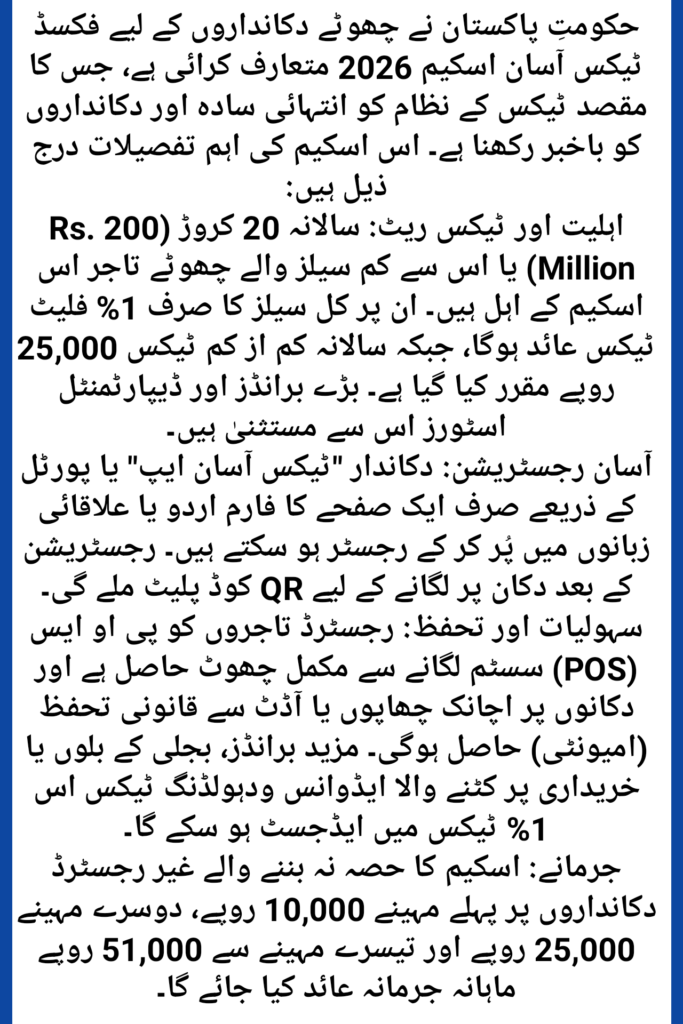
At the heart of the new policy is a straightforward calculation: a flat 1% tax on annual turnover (total sales). If your shop generates revenue within the permitted threshold, you no longer need to worry about net profit margins or taxable deductions. You simply compute 1% of your gross sales for the year.
To prevent baseline exploitation, the FBR has introduced a minimum annual floor. Regardless of how low your turnover is, the minimum tax payment under the scheme is set at Rs. 25,000. For a small neighborhood grocery store (karyana store) or a local mobile repair shop, this creates an predictable, flat annual fee that protects them from sudden tax revisions.
Who Qualifies for the Rs. 200 Million Turnover Cap?
This simplified scheme is explicitly designed to safeguard micro and small businesses while excluding massive retail chains. The FBR has established a strict entry ceiling:
- Eligibility Threshold: Your total annual business sales must not exceed Rs. 200 million (Rs. 20 Crore).
- Historical Consistency: The business must not have breached this Rs. 200 million ceiling in any of the preceding three fiscal years.
- Excluded Entities: High-turnover brand outlets, large multi-story department stores, and specialized professional services (such as law firms or high-end clinics) are categorized as Tier-1 retailers and are completely ineligible for this flat-rate relief.
Practical Application: Digital Compliance and On-Site Rules
Business owners frequently worry about harassment by field officers entering their premises. The 2026 framework introduces digital safeguards to drastically limit physical contact between shopkeepers and tax collectors.
REGISTRATION VIA TAX ASAAN / PORTAL │ INSIDE THE SCHEME OUTSIDE BOTH REGIMES –
Exempt from Point of Sale
“(POS) – Month 1 Penalty: Rs. 10,000
Immunity from arbitrary field raids – Month 2 Penalty: Rs. 25,000
Lower withholding tax on purchases – Month 3 Penalty: Rs. 51,000”
The One-Page Local Language Registration Process
The registration barrier has been intentionally lowered. Shopkeepers can sign up through the FBR online portal or the updated Tax Asaan Mobile App. The registration form is limited to a single page and is available in multiple regional languages to ensure maximum accessibility.
Once successfully registered, the FBR issues a unique, official QR-coded compliance plate. This physical plaque displays the merchant’s name, National Tax Number (NTN), and business name. Prominently displaying this plaque inside the shop serves as immediate proof of tax compliance.
Can FBR Officials Enter Your Shop Unannounced?
One of the most reassuring components of the Fixed Tax Asaan Scheme is the explicit immunity from unannounced field audits and shop raids. If a trader displays their QR-coded compliance plaque and keeps up with their 1% payments, FBR field teams are legally barred from entering the premises to audit books or inventory.
Furthermore, participating businesses are fully exempt from the mandatory Point of Sale (POS) digital integration software, saving small shop owners from buying expensive electronic invoicing hardware.
Comparing the New Scheme with Normal Tax Return Filing
Choosing between the standard income tax regime and this updated fixed model requires analyzing how advance and withholding taxes interact with your daily business transactions.
| Business Attribute | Standard Income Tax Regime | Fixed Tax Asaan Scheme 2026 |
| Tax Rate Calculation | Progressive rates based on net profit margins | Flat 1% on Gross Turnover (Sales) |
| Minimum Annual Tax | Dependent on business slab and filing type | Fixed minimum of Rs. 25,000 |
| Record Keeping | Mandatory audit-ready ledgers and expense receipts | Simple track of basic sales and purchases |
| POS System Integration | Compulsory for a widening bracket of retail outlets | Completely Exempt |
| Withholding Tax (WHT) | Standard non-filer penalties apply on imports/supplies | Adjustable against the 1% liability |
Adjusting Your Advance and Withholding Taxes
A notable benefit for registered shopkeepers is the ability to offset taxes already paid at the source. Whenever a retailer purchases commercial inventory, pays an industrial electricity bill, or imports raw materials, suppliers deduct advance withholding tax.
Under this fixed regime, those pre-paid withholding deductions are fully adjustable against your final 1% annual turnover obligation. If your accumulated withholding tax at the end of the year matches or exceeds your calculated 1% liability, your net payable amount drops to zero (provided the Rs. 25,000 baseline is met).
Penalties for Non-Compliance: The Cost of Remaining a Non-Filer
While the government has made entry into the system entirely optional, it has simultaneously introduced strict financial penalties for businesses that choose to remain entirely informal.
The Escalating Monthly Fine Framework
If a shopkeeper stays completely outside the formal economy—refusing both the standard tax regime and the simplified fixed layout—the FBR implements a strict, compounding penalty track to encourage compliance.
- First Month of Non-Registration: A flat penalty of Rs. 10,000 is leveled against the business owner.
- Second Consecutive Month: The monthly penalty escalates to Rs. 25,000.
- Third Month and Beyond: The ongoing penalty climbs to Rs. 51,000 per month, accompanied by potential administrative closures or grid disconnections.
Staying informal under the new fiscal policy is significantly more expensive than paying the minimum Rs. 25,000 annual fixed rate.
People Also Ask (PAA)
What is the maximum sales limit to qualify for the fixed tax scheme?
The maximum annual sales ceiling is set at Rs. 200 million (Rs. 20 Crore). If your business exceeds this revenue threshold in a fiscal year, you must register under the normal corporate or retail income tax laws.
Can a previously registered filer switch to the Fixed Tax Asaan Scheme?
Yes. Existing small taxpayers and filers can transition to this streamlined framework, provided their reported annual turnover did not cross the Rs. 200 million mark during any of the past three fiscal years, and their new calculated tax is higher than or equal to what they paid previously.
Are small traders exempt from Point of Sale (POS) system rules under this scheme?
Yes, shopkeepers enrolled in this program are formally exempt from installing FBR-linked POS software or automated cash registers at their premises.
How is the 1% tax collected from shopkeepers?
Traders calculate 1% of their annual sales volume using the Tax Asaan mobile app or online portal. Payments can be submitted digitally or at authorized bank branches via a simplified payment slip.
What happens if my advance withholding tax is higher than my 1% turnover tax?
If your pre-paid withholding taxes (on commercial utilities, bulk stock purchases, etc.) exceed your 1% turnover liability, they will cover your entire tax obligation for that year, as long as you meet the minimum baseline requirement of Rs. 25,000.
Navigating the New Retail Landscape Productively
The Fixed Tax Asaan Scheme 2026 marks a practical shift toward documenting Pakistan’s massive retail sector. By exchanging complex accounting audits for a reliable 1% turnover rate, the government offers small shop owners a clear path toward active taxpayer status without administrative stress. For the roughly 3.5 million eligible traders across the country, joining this framework provides an affordable way to secure lower withholding rates, build financial credibility, and protect their daily operations from unannounced official scrutiny.
To see a thorough, step-by-step breakdown of how this new 1% tax calculation works alongside real-world examples of one-page registration forms, check out this Chartered Accountant guide on Fixed Tax Scheme implementation. This video offers excellent clarity on how to properly record your annual turnover to avoid common FBR compliance errors.